
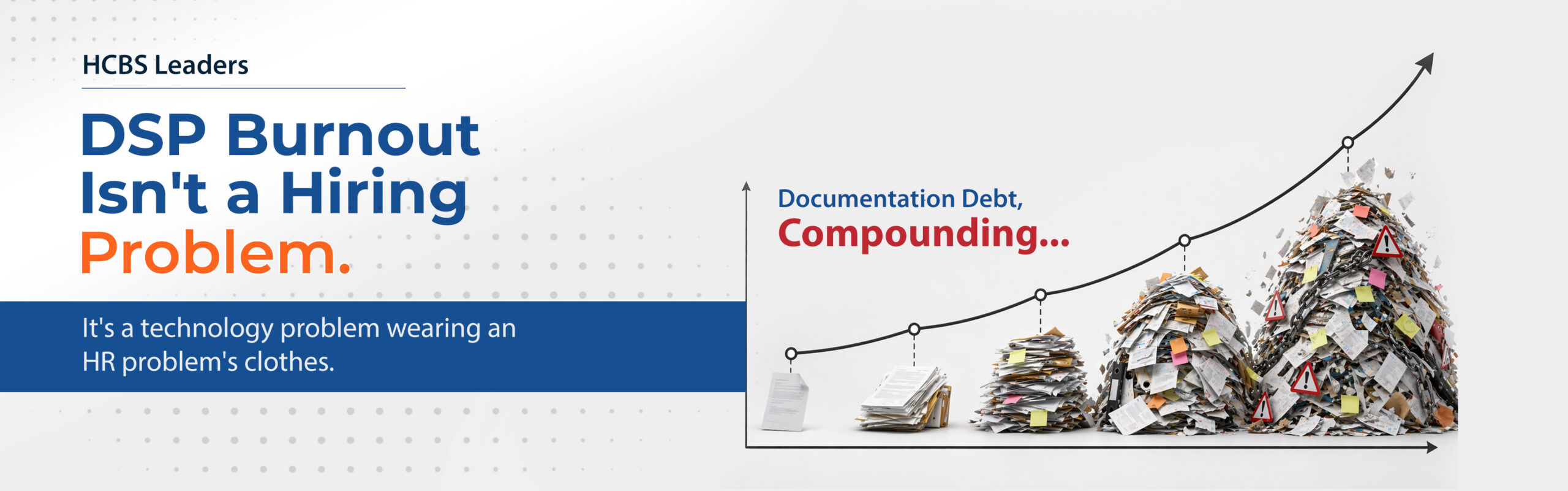
Every agency calls it a staffing crisis. Most agencies are wrong. Here’s what’s actually driving the 40%+ turnover rate — and why throwing more recruiters at it won’t fix anything.
Walk into any HCBS agency in Colorado and you’ll hear the same sentence: “We need more DSPs.”
It’s repeated in board meetings. In job postings. In budget requests. It has become the accepted diagnosis for the entire sector’s pain.
The diagnosis is wrong.
DSP turnover is not primarily a hiring problem. It’s a documentation problem that eventually becomes a hiring problem. And until you see the chain, every recruiter you hire is a bucket under a roof that’s still leaking.
The Chain Every Agency Is Running
Here is the sequence that plays out in every HCBS agency using outdated technology. Each step is invisible on its own. Together, they end Medicaid enrollment.
1. Documentation Takes Too Long
2. Frustration Quietly Builds
3. The Best DSPs Leave First
4. Documentation Quality Collapses
5. The Audit Finds It
Every link in that chain starts with one thing: a DSP in the field, at 8 PM, trying to finish paperwork they don’t understand on a system that doesn’t help them.
Why “Hire More DSPs” Is a Trap
Agencies facing this chain almost always respond the same way: hire more. Pay more. Throw money at the symptom.
Here’s why it doesn’t work:
-
- New DSPs inherit the same broken system. The documentation burden is a property of the software, not the headcount. New hires burn out on the same timeline.
- Training time compounds the problem. Every 4–8 week replacement cycle means reduced capacity plus senior staff pulled away from care to train. Two more DSPs quit during training — and the cycle deepens.
- Wage increases can’t close the gap. A DSP can drive for a delivery app tonight and match their wages — without documentation burden. You are not competing on pay. You are competing on friction.
The agencies breaking out of this cycle in 2026 aren’t the ones outbidding each other for caregivers. They’re the ones who eliminated the reason caregivers burn out in the first place.
What a Technology-First Fix Actually Looks Like
Solving DSP burnout through technology isn’t about “digitizing paperwork.” Most agencies already did that — and it made things worse. It’s about restructuring the work itself:
-
- Documentation in under 5 minutes. Not 45. Structured prompts, smart defaults, and mobile-first workflows that make compliant notes the path of least resistance.
- Guidance built into the workflow. DSPs shouldn’t have to guess what “good documentation” looks like. The system should show them — in the moment.
- One system, not five. Every extra tool is a tax on the DSP’s time. Scheduling, documentation, EVV, incident reporting — unified, not stacked.
- Leadership visibility without manager overhead. Coordinators shouldn’t spend their week chasing signatures. The system should surface gaps automatically.
When you fix these four things, the chain breaks at the first link — and every link downstream stops firing.
Retention is no longer a management problem. It’s a product problem. The agencies that treat it that way are the ones still standing in five years.
The Real Question for HCBS Leaders
Stop asking
“how do we find more DSPs?”
Start asking:
“why are the ones we have leaving?”
The answer, almost always, is in a system that was designed for billing instead of for the person doing the work. Fixing that isn’t an HR initiative. It’s a technology decision — and it’s the most important one your agency will make this year.
See what closing the gap looks like.
Smart Care Technology. Simplified.