
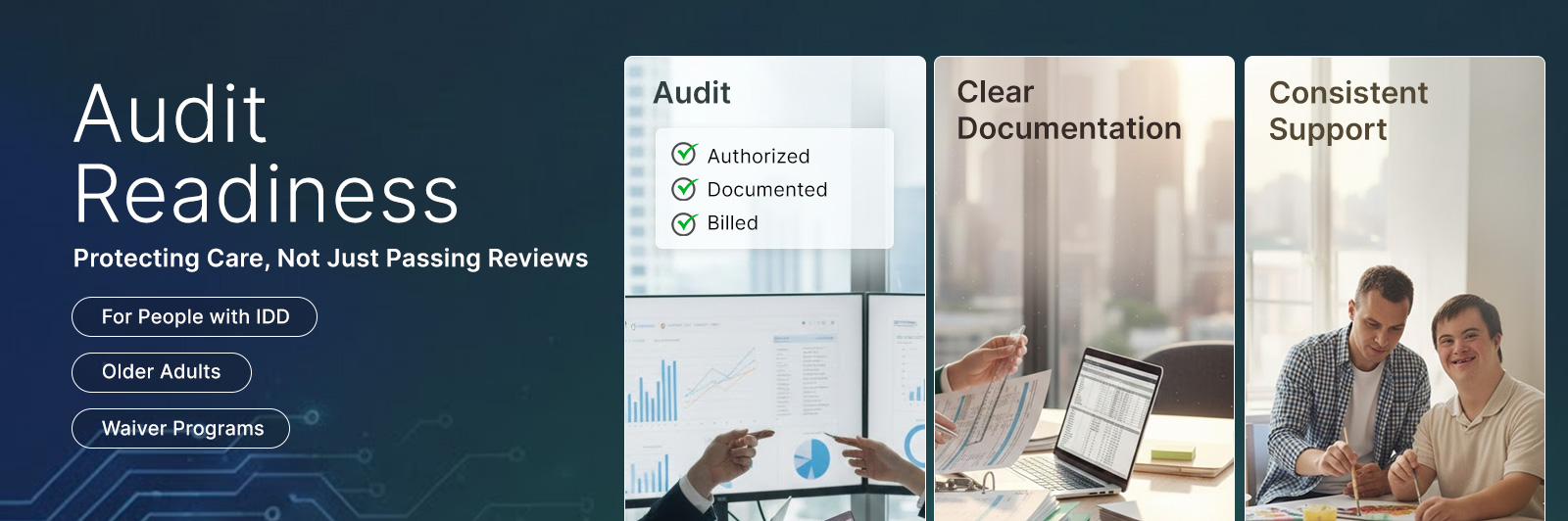
Across the US, increased oversight of Medicaid-funded Home and Community-Based Services (HCBS) programs has made audits, reviews, and payment holds a reality many providers now plan for — not just react to.
While enforcement efforts focus on preventing fraud, they’ve also surfaced a key challenge for legitimate providers: when documentation, Electronic Visit Verification (EVV), authorizations, and billing don’t clearly align, even well-run agencies face disruption.
For our clients—people with intellectual and developmental disabilities, older adults, and others receiving services through Medicaid waivers—those disruptions don’t just affect operations; they can interrupt access to the daily supports we provide and they depend on to live safely and independently in their communities.
Audits Look for Consistency, Not Just Compliance
Most audit findings aren’t driven by intent — they’re driven by inconsistency across systems and records.
Common gaps include:
- EVV records that don’t match service notes
- Services delivered outside active authorizations
- Manual billing corrections that raise questions
- Forms and records spread across multiple systems
Auditors are ultimately looking for one thing: a clear, connected record showing what was authorized, delivered, documented, and billed — without gaps or contradictions.
When Audits Disrupt Services, Everyone Feels It
Audit-related payment pauses don’t just affect back offices or finance teams.
They impact:
- Staff stability and scheduling
- Operational continuity
- And the people with IDD, older adults, and others on waiver programs who rely on consistent, documented services to maintain health, safety, and independence
What Audit-Ready HCBS Providers Do Differently
- Connect Documentation to Billing Automatically
Service notes, EVV, authorizations, and claims are linked — reducing rework and inconsistencies. - Actively Manage Authorizations
Services remain aligned with approved plans, lowering the risk of denials and retroactive fixes. - Centralize Forms and Records
Client, staff, and agency documentation is easy to locate and present during audits or surveys.
Audit readiness becomes part of daily operations, not an emergency response.
Confidence Comes From Clarity
For HCBS providers, trust is earned through transparency.
Clear, connected systems support:
- Families seeking reliable care
- Case managers responsible for oversight
- Funding agencies ensuring program integrity
When documentation tells a consistent story, providers spend less time defending care — and more time delivering it to the people they serve.
Looking Ahead
In today’s regulatory environment, audit readiness isn’t about fear or overcorrection.
It’s about clearly demonstrating quality, compliance, and accountability — so services for people with IDD, older adults, and others on waivers can continue without disruption.